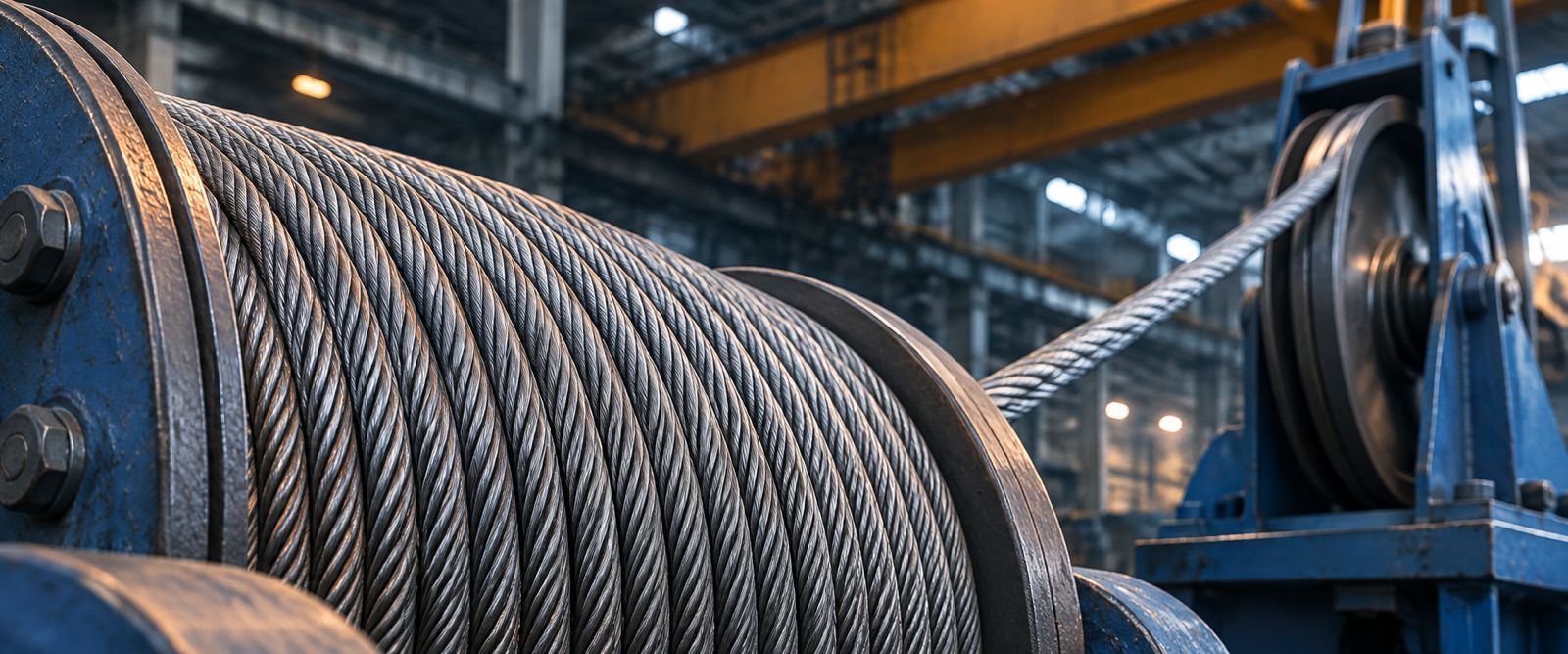
A steel wire rope is one of the most heavily stressed components on any crane or hoist. Each time it passes over a sheave or winds onto a drum, its wires bend, rub and share load. How long it lasts depends on how it is used, and just as much on how it was stored, handled, installed, lubricated and inspected before and during service.
Most of the premature rope failures we see in the field come from avoidable causes. These include ropes that corroded on the shelf, kinks introduced during unreeling, sheave grooves that no longer match the rope, and deterioration that went unnoticed because no one knew where to look. This guide brings together the practices we recommend to customers across the rope's service life, from the day the reel arrives to the day the rope is retired.
How to use this guide
The values given here are well-established general recommendations. Where the crane manufacturer or rope manufacturer specifies a different value or procedure for your equipment, their instructions take precedence.
1. Storage before installation
A rope can lose a significant part of its life before it ever carries a load. Corrosion, contamination and handling damage during storage cannot be reversed. Treat stored rope as a critical spare, not as general stock.
- Store reels under cover in a clean, dry, dust-free and well-ventilated area.
- If outdoor storage is unavoidable, cover the reel with a waterproof sheet or canopy. Make sure moisture cannot collect underneath it.
- Keep the storage area free from steam, chemical fumes and other corrosive agents, and away from sources of heat.
- Do not let the rope rest directly on the floor. Mount reels on a frame or cradle so that air can circulate beneath them.
- Handle reels carefully to prevent impact, crushing or flange damage.
- Keep identification tags, test certificates and specifications with each reel, and issue stock on a first-in, first-out basis.
- Inspect stored rope at regular intervals. Where needed, apply a rope dressing compatible with the manufacturing lubricant.
- Rotate the reel about every three months, especially in warm climates, so that lubricant does not drain towards one side of the rope.
2. Pre-installation checks
A replacement rope must suit the whole reeving system, not just the drum. Matching the nominal diameter alone does not confirm compatibility. Before fitting, check the following.
- Rope specification: construction, nominal diameter, grade, lay type and direction, length and end terminations, all checked against the equipment documentation.
- Rope condition: look for transit damage, corrosion, flattening or other visible defects on the new rope.
- Sheaves: groove profile, wear, corrugation and damage. Confirm that every sheave turns freely on its bearing.
- Drum: groove diameter and pitch, flange condition, rope anchorage and spooling arrangement.
- Rope path: plan the reel position and lead so that the rope does not bend unnecessarily, twist or rub against structures.
Measuring the new rope
Measure the actual diameter of the new rope with the rope free of tension, using a caliper with broad jaws across the strand crowns. Record the value. It is the baseline for every diameter-reduction check made later in the rope's life.
Groove sizing
| Parameter | Recommendation |
|---|---|
| Sheave groove diameter vs. nominal rope diameter | Approximately 5% to 10% larger |
| Sheave groove diameter vs. actual new rope diameter | Ideally at least 2.5% larger |
| Oversized grooves | Avoid. The rope loses side support, flattens and wears faster. |
| Undersized or worn grooves | Avoid. The rope is pinched, which damages outer wires and the core. |
Do not proceed if something does not match
If the rope, grooves or equipment appear incompatible, stop and have the system assessed before installation. A new rope run on worn or mismatched sheaves can be damaged within a few cycles.
3. Unreeling and handling
Incorrect payout is one of the most common causes of early rope damage. Adding or removing turns, loops, kinks and reverse bends can permanently change the rope's structure, even after it appears to have straightened out again.
General practice (6- and 8-strand ropes)
- Never pull rope off a stationary coil or reel. The coil or reel must rotate as the rope is drawn off.
- Small coils may be rolled out along clean ground in a straight line. Place heavy coils on a turntable and pull the free end away from the coil.
- Pass a shaft of adequate strength through the reel bore and support it on a stand, so that the reel turns freely.
- Fit a braking arrangement to stop the reel overrunning.
- Keep the rope clear of the ground and away from dust, grit, moisture, chemicals and sharp edges.
- Transfer rope from reel to drum "top to top" or "bottom to bottom" to avoid a reverse bend.
- Take particular care when releasing the outer end of the rope from the reel or coil.
Additional care for rotation-resistant (multi-strand) ropes
Rotation-resistant ropes rely on a carefully balanced arrangement of inner and outer strand layers, laid in opposite directions, to limit rotation under load. This construction is easily disturbed, so these ropes need stricter handling.
- Pay the rope off so that no turn is put in or taken out.
- Short lengths of small-diameter rope, up to about 100 m, may be rolled out along the ground under control. Larger sizes and longer lengths should always be supplied on reels and never rewound onto coils.
- A long rope on a reel has high rotational inertia. Brake the reel effectively. A timber plank pressed against the reel flange makes a simple and reliable brake.
- For an under-winding drum, take the rope from the bottom of the reel so that it is not reverse-bent during reeving.
Never pull a loop tight
If a loop forms, stop and open it out by hand. A loop pulled tight becomes a kink, and a kinked rope is permanently distorted and must be discarded.
4. Seizing and cutting
Seizing holds the strands in place when the rope is cut. Without it, the strands of the inner core and outer layer slip relative to each other. In a rotation-resistant rope, this upsets the torque balance designed into the rope and can cause birdcaging or core protrusion once the rope is in service.
- Before cutting, apply tight double seizings of soft steel wire of suitable size on both sides of the intended cut.
- Each seizing should be at least 2 × d long, where d is the nominal rope diameter.
- Space the seizings approximately 6 × d apart.
- Multi-strand ropes are normally supplied with fixed ends. If one must be cut on site, apply at least three tight servings of soft seizing wire on each side of the cut.
- Fusing the cut ends is strongly recommended.
- Adhesive tape is not a substitute for seizing and should not be used for this purpose.
5. Installation and spooling
- Follow the equipment manufacturer's reeving diagram and winding direction.
- Make sure the rope runs in the correct groove of every sheave and guide, with no rubbing on the structure.
- Keep the tension constant during reeving.
- On multilayer drums, apply back tension and wind the first layer tightly. A loose bottom layer lets upper layers cut in and crush the rope beneath.
- Prevent slack turns, layer cross-overs and trapped rope.
- Fit terminations and drum anchorages using the approved procedure and components only.
Fleet angle
Keep the fleet angle as small as possible. If space does not allow the rope to be paid out in a straight line, position the reel and stand so that the fleet angle during installation does not exceed 1°30'. In practice, this means allowing about 40 m of horizontal distance for every 1 m of width between the reel flanges. A longer run is beneficial wherever space allows.
6. Running-in a new rope
Running-in lets the strands and wires settle into their working positions under gradually increasing load, before the rope goes into full service. Where the crane manufacturer specifies a commissioning procedure, follow it. Where none is specified, the following sequence is widely used.
| Stage | Load | Cycles | Speed |
|---|---|---|---|
| 1 | About 25% of SWL | 6 full in-and-out cycles over the maximum working length | Reduced |
| 2 | 50% of SWL | 6 cycles | Reduced |
| 3 | 100% of SWL | 6 cycles | Reduced |
While running in:
- Keep all personnel clear of suspended loads and moving rope.
- Watch the rope tracking, drum spooling and sheave rotation.
- Listen and look for abnormal noise, vibration, twisting, slack or irregular winding.
- Stop immediately if the rope behaves unexpectedly or shows visible damage.
Load testing
Full-load and proof-load testing must follow the approved equipment procedure and be carried out by qualified personnel. Never improvise them.
7. In-service inspection
Inspection is more than counting broken wires. Deterioration can develop internally or in areas that are hard to reach. Set the inspection frequency according to the equipment duty, the operating environment, the applicable standard and the manufacturer's instructions.
| Condition | What to look for |
|---|---|
| Broken wires | Individual breaks, concentrated groups, breaks in strand valleys and breaks at or near terminations |
| Diameter reduction | Measured diameter compared with the recorded new-rope baseline. A reduction indicates wear, loss of metallic area or core deterioration. |
| Corrosion | Rust, pitting, dry or degraded lubricant, and moisture trapped at the core |
| Deformation | Kinks, crushing, flattening, birdcaging, waviness, protruding wires or core, and strand displacement |
| Heat damage | Discolouration, burnt lubricant, and marks from electric arcing |
| Terminations and equipment | Sockets, ferrules and clips, plus wear on sheaves, drums and guides |
Where to look most closely
- Rope sections that bend repeatedly over sheaves during each lift
- Cross-over and layer-change zones on multilayer drums
- The rope next to end terminations and drum anchorages
- Sections exposed to abrasion, contamination or corrosive conditions
- Any length that has been through an overload, shock load or abnormal event
In 6- and 8-strand ropes, wire breaks occur mostly on the outer surface where they can be seen. In rotation-resistant ropes, most breaks develop internally and may not be visible at all. These ropes may need specialist methods such as magnetic rope testing (MRT), as assessed by a competent inspector.
8. Discard criteria
A rope must be taken out of service once inspection shows that deterioration has passed the permitted limits. Four main factors are assessed: broken wires, diameter reduction, corrosion and deformation. Any one of them can justify discard on its own if it is severe enough. In practice, though, the decision is usually driven by several factors acting together, and the rope must be judged on that combined effect.
Permitted broken-wire numbers and diameter-reduction limits depend on the rope construction and application. No single figure applies to every rope. Use the criteria in the applicable standard, such as ISO 4309, for your specific rope. In addition, the following conditions call for action regardless of the counts.
| Finding | Required action |
|---|---|
| Visible broken wires equal to or above the permitted number | Discard |
| Complete fracture of a strand | Discard immediately |
| Collapse of the core | Discard immediately |
| Kink or other permanent distortion | Discard immediately |
| Close group of broken wires within a length of 6 × d, or concentrated in one strand | Discard, even if the permitted number has not been reached |
| Wire breaks in the strand valleys | Treat as a sign of internal deterioration and examine the rope closely over a length of 6 × d around the breaks |
| Broken wires at or next to the termination | Shorten the rope and remake the termination. If that is not possible, discard. |
| Significant corrosion, abnormal diameter reduction, heat or arcing damage | Stop use and have the rope assessed by a competent person |
When in doubt, take it out
If a potentially dangerous defect is found, stop using the rope and secure the equipment against operation. Do not return it to service until the condition has been assessed and corrected. A rope's age, or the small number of visible defects, is never a reason to keep it in service.
9. Maintenance: do's and don'ts
Good maintenance slows deterioration, but it cannot restore a damaged rope. Lubrication protects against corrosion and internal wear. It does not repair broken wires or deformation.
Do
- Lubricate with a good-quality, acid-free and moisture-free lubricant compatible with the original rope lubricant.
- Inspect sheaves, rollers and drums regularly. Rope life depends heavily on their condition.
- Inspect ropes, fittings and terminations at regular intervals.
- Investigate the cause of abnormal wear instead of only treating the symptoms.
- Keep records of inspections, defects, corrective actions and replacements.
Don't
- Don't let ropes deteriorate in storage.
- Don't mishandle ropes during uncoiling or unreeling, or let kinks form.
- Don't use Lang's lay rope with a swivel on standard 6- or 8-strand ropes.
- Don't run ropes on drums or sheaves with oversized grooves.
- Don't cut a rope without seizing it first.
- Don't load a rope beyond its safe working load. A reduced safety factor endangers the rope, the equipment, the job and the people around it.
10. Quick checklist
Use this as a reminder, not as a replacement for your equipment's approved inspection procedure.
- Rope identification and specification verified against equipment documentation
- Storage conditions and preservation checked; reel rotated periodically
- New rope diameter measured without tension and recorded
- Drum and sheave grooves checked for size, profile and wear
- Reel mounted on a shaft and stand with braking; payout direction confirmed
- Seizing applied before any cut; cut ends fused
- Fleet angle, reeving path, terminations and spooling checked
- Running-in completed per the approved procedure
- Inspection frequency and discard criteria established
- Inspection findings and corrective actions recorded
11. Standards and references
- ISO 4309:2017, Cranes: Wire ropes: Care and maintenance, inspection and discard. Adopted in India as IS/ISO 4309:2017. A revised (sixth) edition is under development at ISO.
- EN 12385 series, Steel wire ropes: Safety. Refer to the part that applies to your rope type and application.
Standards are revised from time to time, and which one applies depends on the equipment, the application and the jurisdiction. Confirm the current edition before relying on it for operational decisions.
Safety notice
This article provides general technical information for wire rope users. It does not replace the rope or equipment manufacturer's instructions, competent-person inspections, applicable standards or statutory requirements. Rope selection, installation, testing, inspection and retirement must be decided by qualified personnel for the specific equipment and application.